Let’s Talk About the Inaccessibility of Modern Art

There’s a certain segment of the population that seems to perpetually bemoan the lack of curious consumers.

We sit around at bars discussing the lack of an audience for theater, music or art, and host panels seeking to discover how we build the new audience for art, theater or classical music.

Why are there so few people interested in stepping out of their comfort zone and experiencing something new?

In the theoretical once upon a time, and probably the actual one, everyone (or at least most) read about art. Everyone went to the theater. Everyone knew the composer of the day. Everyone discussed the arts and everyone loved them.

Then the 20th century happened. In the words of composer and critic Theodor Adorno, “New music has taken upon itself all of the darkness and guilt of the world.” Sure he was referring to music but the assertion could just as easily be broadened to include the entire world of art.

European and American artists and composers and writers in the early 20th century saw violence like the world hadn’t seen for hundreds of years. The manifold amount of changes wrought by technology and innovation in fin de siècle Europe and America meant nothing about life before would ever be the same. Then World War One and World War Two turned the world completely upside down. How could we go back to the way the world was before? The answer was that we couldn’t.

Modernism was here.

This sense of unease and uncertainty about the future and growing economic disparity, complicated by death on an unforeseen scale, inevitably made its way into the art world with dramatic results.

“Everything purely aesthetic has no cultural value,” philosopher Otto Weininger once said, more or less capturing the zeitgeist of art in the early 20th century.

The bourgeois worship of art, in the words of Alex Ross, turned modern artists away from aesthetics at the same time as it “made possible the extremes of modern art.”

Artists were infallible, as they had been for many years, but all of a sudden artists began increasingly isolating themselves. Adamantly rejecting the tastes of the masses, their creations became more and more difficult, almost impossible for most people to understand, but we were more or less forced to accept them. The incomprehensibility of life demanded nothing less.

The history of 20th century art is a study in revolution and counter-revolution; a continuous struggle on the part of artists to move further and further away from public taste and approval into an insulated world of other artists and the like-minded that could appreciate their complex, physical art and music. Familiarity was totally rejected.

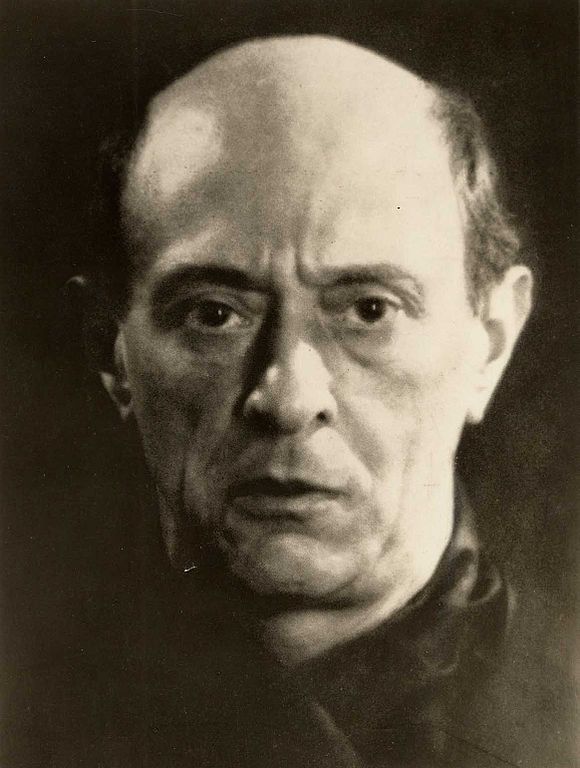
In the words of Schoenberg, “If it is art, it is not for all, and if it is for all, it is not art.”

Arnold Schonberg
Arnold Schonberg

Artists and musicians didn’t need or want the public, something brought to a culmination with composer Milton Babbitt’s admonishment to isolation, “Who cares if you listen?”

Who cares indeed.

Which brings me to my point. I’m edging closer and closer to the conclusion (and for those of you who reached it years ago, don’t hate), that contemporary artists, musicians, etc., don’t want you to like their work. When art became conceptual, cerebral and philosophical, it forced artists into a world of art education in which technique matters, but only in relation to the idea, which is paramount. Naturally the ability to elucidate the idea takes practice, often years of it, practice which is aided by arts institutions who have commodified centuries of art into these ideas, offering classes in critical theory and performance studies.

When an artist spend as much time thinking as they do creating, it’s little wonder they emerge with a rather stilted way of talking to and interacting with those who haven’t devoted years of their life to academics.

That of course translates to their art, and well, we’re left with Babbitt.

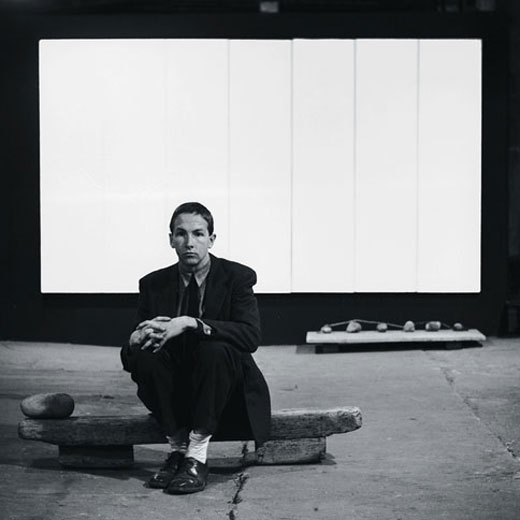
Rauschenberg with White Painting
Rauschenberg with White Painting. Yes, it’s art. But mostly it’s an idea.

I say all of this not to villainize the over-educated artist. I understand. If I too could throw around Wittgenstein’s ideas like I was discussing something that happened yesterday, I’m sure I’d have a hard time not feeling like my art was above most people’s level of comprehension.

I say all of this as well, knowing full well that there are numerous artists making work that is easily accessible by large swathes of the population and does not suffer critical revulsion in spite of its lack of academicism, (although typically there is a very academic explanation for even an apparently unacademic work of art).

I say it simply because it is. And it’s a massive shift in the way art has historically been approached and created. AND it’s a transformation in thought that doesn’t get a whole lot of discussion.

I don’t know if it’s a good thing or a bad thing. I personally enjoy digging into the research behind the work, learning more about the theorist who or personal history that informs a work. But I understand that many people don’t and/or don’t realize that that is now part of the artist/audience contract.

Schoenberg was one of the first to express the ideology behind the new art that was defined by its inaccessibility rather than vice versa, but he helped to launch a revolution in the ways we do or don’t approach art. It is what it is. But lets stop pretending like it isn’t.

overcoming fear and engaging with art

I’ve long struggled with the difficulty we have in approaching ‘modern art.’

I’ve written previously on the complicated nature of beauty and innovation, the ideas on which, for many years, our acceptance of art, or lack thereof, was based.

It goes without saying that most art today is not beautiful insofar as we have historically understood that term. And it is immediately obvious to most who wander into art galleries and museums today that technical ability and innovation is also not always easy to determine.

Art today is based on ideas, so what, as one unfamiliar with an artist’s ideas, are we to make of this new art?

There’s no easy answer as I’m discovering, but a recent Brain Pickings post pointed me to a little book called “Art as Therapy” by Alain de Botton and John Armstrong.

The title immediately conjured images of people in hospital rooms with Monet’s lilypads gracing the walls for me, but the word therapy in this case is I think a little misleading. I would propose a more appropriate characterization. Art as a means to living a better life.

De Botton and Armstrong propose using art as a way to help us communicate our emotions to others or illuminate half-formed thoughts, for example.

In particular, the two discuss art as a method of overcoming our very human fear of the ‘different.’

In de Botton and Armstrong’s therapy, as in I would imagine, most therapy, they expect full engagement. In attempting to overcome their fear the art-goer would undertake three steps.

1. Acknowledge the strangeness we feel encountering art that is new or different and allow ourselves to feel it
2. Get to know the minds of those that created the art (potentially through reading, a study of the culture or writing of the artist, and so on)
3. Look for points of connection with the artist, however tenuous and embrace them

It may sound rather pedestrian and obvious, but at least, for me, reading such an obvious roadmap of how to ‘overcome fear’ through art, made me think, for the first time, that perhaps it’s fear that discourages us from engaging with art and therefore understanding it.

The more I think and the more I read, my rather lengthy attempt to understand our society’s utter lack of interest in and understanding of art, and in this case I mean auditory, visual or performing art, has been rather misled.

In looking for ways to explain away the elitism inherent in fine art, and blame the art world itself, I’ve failed completely to account for our own complicity in the art world’s growing insularity.

A certain contingent of the art world will always believe art (especially that made in the last century) is reserved only for a select few, the sentiment being expressed rather curtly by Arnold Schoenberg in a quote I recently came across, “Art is, from the outset, naturally not for the people.” Despite the snobbish view of some, I don’t think that is the only viewpoint held by currently working artists.

It’s my understanding that some artists actually appreciate the public’s engagement with their art, instead of shunning it, but engagement implies the expense of energy.

Instead of stopping at “I don’t understand,” we would have to move to step two, “get to know the minds of those that created the art,” and that’s where the going gets difficult.

Just as with anything truly worthwhile in life, understanding and appreciating art isn’t easy, but not only can an attempt to do so improve your life (and your conversation skills), it can also help you overcome fear.

the complicated nature of art and criticism in the contemporary world

People that truly appreciate art and architecture often appreciate most of all an artist’s ability to create something new. To force us to think about something in an entirely new way, to invoke surprising feelings or to stimulate curiosity and possibility.

But that appreciation is often based on nothing more than vague, ethereal reactions we may have towards a visual or auditory object and our experience of it.

Can the value of art really be summarized in such vague, emotive and all too relative judgements? And if so, why is our society’s engagement with art steadily shrinking?

Once upon a time, 150-200 years ago, art was beautiful. Not that it isn’t now. But once upon a time, we had one definition of beauty.

A lot has happened in those 150 years. In our headstrong rush towards a pervasive relativism, art, naturally, got complicated.

It was inevitable. We have lived through more life-altering evolutionary churning in the past century than many before us combined, technology being perhaps the main contributing factor in the change.

Existence is no longer simple. We’re used to that.

But despite the manifold amount of change, for some reason, the cultural dialogue surrounding art is much the same as it was 150 years ago.

Certainly we’ve adjusted for the conceptual nature of the art object and the philosophical nature brought along with a redefinition of art. But despite the relativistic society in which we live, a community in which anything goes, and I dare not press my religion, cultural ideology, style, taste in music, etc. on you, the art world still functions as it did before. An exclusive cadre of ‘critics’ and ‘academics’ determines who enters into the halls of the fine art world and that same club of art experts determines how we should talk about them.

The nature of today’s artists too has exacerbated the exclusivity of the art world. It is no longer enough to have a knack for painting or sculpture, in fact, you’re almost better off if you don’t. Today’s artists aren’t artists in the 19th century sense of the word, today’s artists are philosophers.

Artists have always been thinkers, I know this. It would be impossible to create even the simple beauty of Rembrandt or Van Eyck without a deep understanding of humanity, the world and religion, an understanding only possible through years of thought and meditation.

But today’s artists don’t stop there. They don’t meditate on just the world and humanity, allowing their understanding derived therein to inform their art. No. Relativism and the steady decline of our interest in, and ability to decipher, traditional philosophical writing, have combined to make today’s artists into today’s philosophers. Partly out of necessity and partly out of the complicated nature of beauty and taste in today’s world. An understanding of life today, after all, is inextricably tied to much more than religion and nature thanks to the suffocating grip of technology.

And if today’s art also functions as a stand-in for today’s philosophy, then art critics more or less, function as philosophers in their own right.

100743

Raphael Rubinstein writes in a recent review of MoMA’s Sigmar Polke Retrospective on the “mania for explanation,” wondering when it became such an imperative that artist’s explain their work to their audience.

“It’s as if their works never go out into the world without the company of their voices, which come to us via interviews, artist statements, video documentaries, panel discussions and artist talks,” he says.

Rubinstein’s arrogant bewilderment on this matter is an excellent illustration of the art world’s obliviousness to its own insularity.  When art is philosophy the artist statement and generally intimate knowledge of the artist’s worldview is imperative to an understanding of the art. Certainly once you’ve had the years of experience of a Rubinstein or otherwise, you may be able to deduce an artist’s objective without background. The rest of us, however, remain lost.

He then transitions into Sigmar Polke’s apparent refusal to explain his work. The few times Polke did speak in public almost always consisted of less than sincere responses to interview questions and art-world parody.

I don’t pretend to know why Polke refused to explain his own work but I would postulate it has much to do with a conscious rejection of what the art world was becoming.

Despite the rejection of Rubinstein, and I’m sure others, we started down the path of lengthy explanation when we began appreciating art less for its beauty and more for its originality in regards to the artist’s intention.

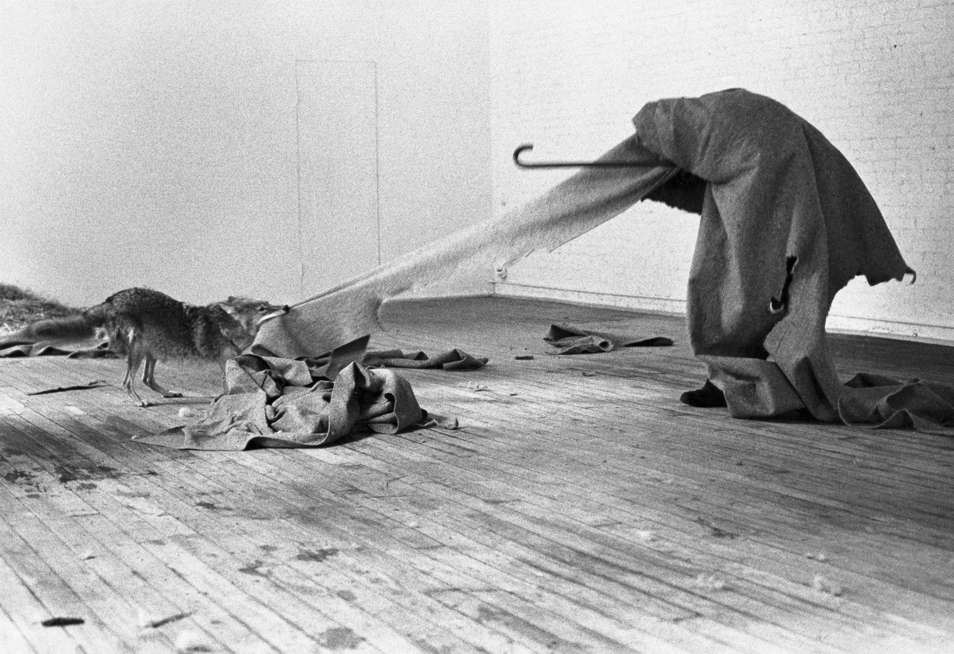
beuys_coyote_09_sized1

It’s elitist to expect the casually interested art lovers to understand why Joseph Beuys locking himself in a room with a coyote for several days is worthy of our attention and respect without written and verbal explanation from Beuys himself, and the critics who support him, of the philosophical underpinnings which prompted the exhibition.

If Beuys wanted to be taken seriously, and even have a gallery willing to support the performance in the first place, he needed a damn good reason. And that proposal and artist statement had to be good enough to impress the critics and thereby the public.

The writing is necessary.

And here’s the rub. I’ll go with Rubinstein to the natural conclusion of all of this, the need for explanation has given rise to too much explanation. Too much explanation at the expense of emotional response.

Once upon a time, when beauty was simple and writing wasn’t vital to our understanding of a work of art, we were allowed to emotionally react to a painting or sculpture, although the range of emotions we allowed ourselves was almost certainly smaller 150 years ago.

The philosophy of today’s art is a double-edged sword.

On one hand, art as the expression of a philosophical construct or ideological deconstruction allows the possibility to engage with a piece of art on a deeper level and to experience one of today’s most influential expressions of philosophical thought, on the other, when our discussion of art seems to imply that is the only way to respond to a piece of art, we’re excluding the audience who would choose to engage with art on a more feelings-based, reactionary level.

And that’s where the art world has acted against the public in its perpetuation of a form of art writing that doesn’t allow for individual taste and the possibility that art can be appreciated in its own right in the context of our visual and emotional responses.

Where does that leave us?

With an insular art world that refuses the rest of us the experience of our own “possibility” with art, as Jeff Koons puts it.

We’re left with a public who insist they “don’t understand it” and therefore cannot, and do not, meaningfully engage.

jeff-koons-woman-in-tub

We spend so much time writing and thinking about how important art is, and performing academic studies on how our “brains are wired to appreciate art” and how art uplifts us, feeds our spirit and on and on and on. But most of us cannot appreciate art because we’re still trapped in the endless cycle of self-perpetuated ignorance, a cycle in which the art world is complicit and unsympathetic.

Koons puts it simply. “I create art to inspire feelings,” Milton Glaser puts it another way when he says “The deepest role of art is creating an alternate reality.”

Put in my words? Art can very much be about sensation and emotional response and for many artists that create, that’s all that it is.

Therefore, it should be about learning what you like, not what the critics like, and not what is (necessarily) in museums.

The catch?

You have to expend the effort to discover what you like. That means curiosity, discovery and engagement.

Yes, art will still remain complicated and contemporary art will always be something of a mystery, even to many of the critics who engage with it daily. But maybe it doesn’t have to live only in the realm of academia, maybe art can continue to evolve and our appreciation of it, flourish yet again. Maybe fine art can once again be a part of the popular culture conversation.

What happens when alternative culture is co-opted by the mainstream?

David Foster Wallace may have been one of the most outspoken cultural critics to point out that although at one point irony was a powerful weapon of artistic response, especially in the 60’s and 70’s when trust in establishments such as the government seemed especially misplaced, irony has since become so mainstream it is now necessary in the creation of art simply in order to achieve acceptance. To imply your cultural complicity.

Sukhdev Sandhu, another cultural critic, refers to the same in an essay on music in which he describes the trajectory of critically acceptable music. The sentimentality and ‘schmaltz’ of earlier musical periods has been replaced in the recent past with the idea that music’s value is defined more by its ‘realness’ and ‘truth.’ Scholarly writing on music today looks for neophilia, an illustration of the musician’s subcultural awareness, or, as in Wallace’s take on irony, resistance towards the mainstream. Emotion, ‘yearning,’ as Sandhu says, is rejected, critical acceptance being reserved for the alternative.

The problem?

The alternative has now become the mainstream.

We’ve reached a point in Western culture at which everything we once viewed as revolutionary or anti-establishment has become the establishment.

Sure irony was once a culture’s useful critique, a tool to “Lay waste to corruption and hypocrisy,” to respond to the vapidity of US culture. Certainly, the emergence of ‘alternative’ music in the late 20th century; the anarchic sound of the Sex Pistols or the vocalization of a marginalized subculture in early West-coast rap, served as a much needed dose of reality in a world whose popular music had for too long been dominated by the majority.

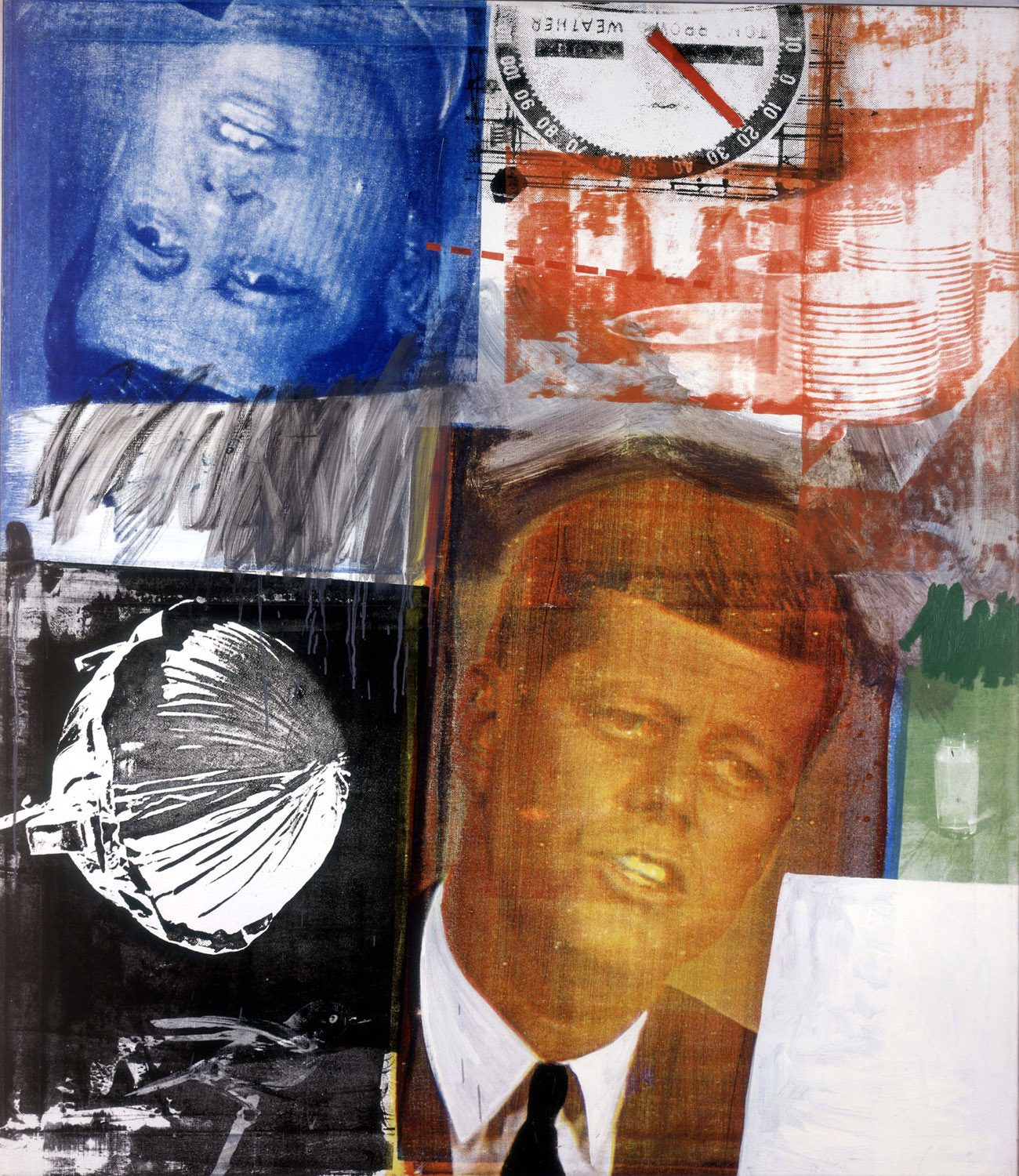
But imitating the revolutionary work of a Thomas Pynchon or a Robert Rauschenberg or recreating the sound of 2Pac or the Ramones isn’t, in and of itself, grounds for artistic acceptance. A groundbreaking new way of making art is groundbreaking in its novelty. When the work is recreated, the revolution is over, and, well, you get where I’m going.

Robert Rauschenberg - Untitled, 1963
Robert Rauschenberg – Untitled, 1963

When Mike Will Made It produces Miley Cyrus’s albums. When LA’s Hammer Museum produces a show of artists who practice institutional critique. When upper middle-class teenagers wear GG Allin t-shirts….

The ‘alternative’ has lost its definition.

David Foster Wallace:

And herein lies the oppressiveness of institutionalized irony, the too-successful rebel: the ability to interdict the question without attending to its subject is, when exercised, tyranny. It [uses] the very tool that exposed its enemy to insulate itself.

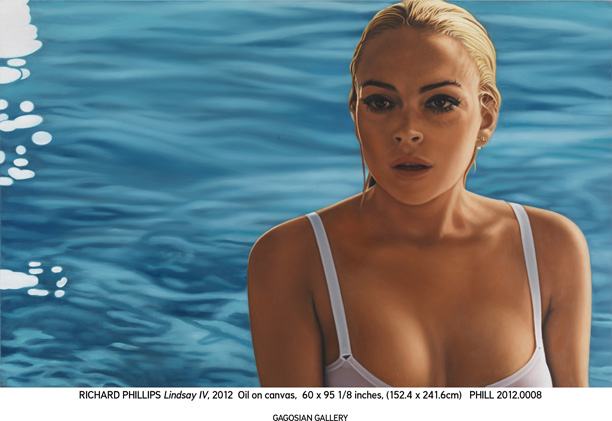
Whether its irony or some other form of cultural critique in art or music, when something becomes what is expected, we stop trying. When artists, I’ve heard the example of Richard Phillips, can create insincere art contributing nothing new to the conversation, and we are more or less asked accept it at face value ‘because it’s ironic,’ we’ve begun the gradual destruction of an intelligent culture. We’ve stopped asking questions and we’ve stopped having to explain ourselves, assuming, because we are perpetuating cultural norms, our work is self-evident and valid in its own right.

phill-2012-0008-web

And irony (insert other culturally acceptable means of expression here) means safety.

So what’s next?

In short, the risk of failure. The risk inherent in creating art that is different and perhaps in direct contrast to what the art world has been trained to accept. Risk being labeled sentimental or ‘full of conviction.’ And perhaps the idea of good art can move past irony into sincerity into an art that can ‘open possibilities for the future’ instead of wallowing in its own nihilism and irony. After all, being right is the opposite of being original. You can’t be both.

The move in music criticism towards acceptance and the well-argued and well-defended justification of divergent musical styles once considered inauthentic, naive or simplistic, is a start. When other art forms, visual art in particular, can begin to ask the same of its critics, perhaps a new kind of artist will again grace the spotlight and the age of an absolute which requests the ironic or the rebellious before originality and authenticity can be granted, will be over.

Musings 4.21.14

Words mean more than we mean to express when we use them, so a whole book ought to mean a great deal more than the writer means.

– Lewis Carroll

One of Salvador Dali's illustrations for Alice in Wonderland
One of Salvador Dali’s illustrations for Alice in Wonderland


Nothing is original. Steal from anywhere that resonates with inspiration and fuels your imagination. 

– Jim Jarmusch

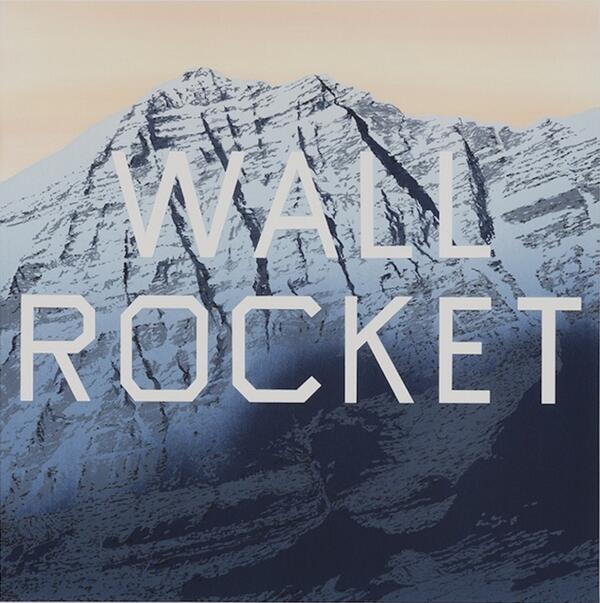
BlhhMIVCUAAS1hd
Ed Ruscha

I’ve recently been spending an inordinate amount of time with two things. Generational theory, which attempt to understand and explain why we are the way that we are, and writing on criticism as we attempt to explain how we analyze and evaluate music today.

Unlike the generations which have preceded us, mine, the millenial generation, first and foremost identifies themselves individually. We don’t seek to fit in with a ‘group’ instead we pride ourselves on our individuality, our style, our taste etc.

How we define ‘cool’ is different too. According to writer Alexandra Molotkow, being cool is no longer based on what you know and other people don’t. Being cool is about what you have to say about thing things everyone else already knows.

This manifests itself in conversations third-party listeners often think sound pretentious or unintelligible. We’re so consumed with having an opinion and demonstrating our cultural capital and understanding of theory, that we have taken to re-evaluating everything those who came before us dismissed.

We’ve collectively revolted against elitism and our critical technique is to evaluate, to our credit, everything previous critics outright rejected as kitschy, pedestrian, low-brow (pick your negative word), etc.

Molotkow however, talks about the danger’s of this culture of acceptance we’re cultivating, and the risks inherent in ‘poptism’s’ all-encompassing policy of acceptance, by asserting that it’s one thing to defend the music of a Justin Bieber, it’s another to offer him a place in the music history canon.

The challenge for today’s critics and an idea which will undoubtedly continue to evolve as yet another reaction to what came before it in the history of music criticism, is the need to ask the right questions of these pop stars we insist so vehemently on defending. ‘Does this pop song do what a pop song should do?’ ‘Does it succeed or fail by updating, employing or subverting its genre tropes?’ These are the questions we should be asking and they’re hard ones.

Mindfully evaluating genres of music within the theory of the genre as opposed to a blanket comparison between genres will become the dominant theme in music criticism for the conscious rejecters of both rockism and poptimism, and as we descend into an ever more critical place may we all become smarter and more critical without resorting to yet another form of elitism.

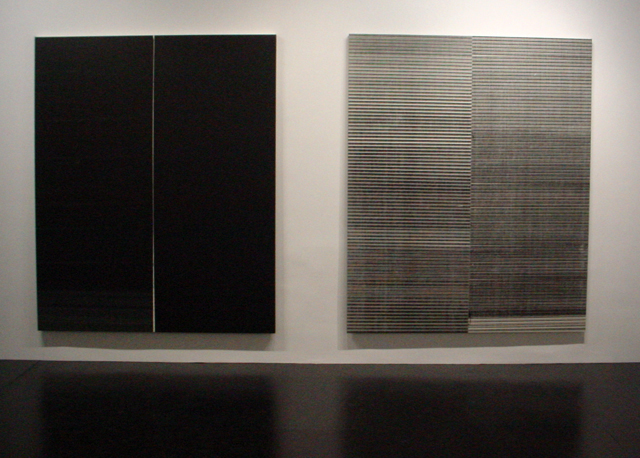
Wade-Guyton-“untitled”-2014-b
Wade Guyton, “untitled” (2014)

Wade Guyton and Post-Media Art

In an art world that seems to accept anything and everything as art, the refusal by some to accept certain computer-made art as art is nonsense.

Another seemingly incongruent fact is the reality that in our post-media world we are starting to accept computer-created art as art provided we remain more or less unaware of the art’s origins in technology.

We are just entering an era in art in which we can accept technology can be the means to create artwork, and not just the subject.

Wade Guyton’s untitled pieces above serve as a good meditation on new media art. Their origin belies their creator’s hand while at the same time darkly prophesying a future of machines and machine-produced art.


Musings. 4.6.14

Fail. Fail again. Fail better. – Samuel Beckett

Photo by Repeat Pattern

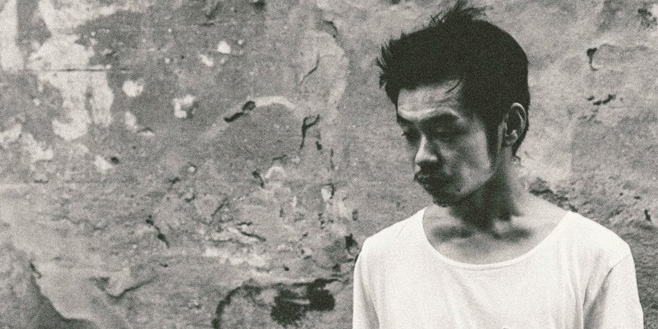
Ryuhei Asano, AKA Lee, makes soundscapey, sample-based music which he pairs with his own drawings in attempt to recreate his feelings. This stuff is good.

The superior man is distressed by his want of ability. – Confucius

Learned from Milton Glaser this week:

  • treat your audience as citizens first and only secondly as consumers. and never treat them as a commodity.
  • the dyad of clarity and ambiguity: allow your work to be ambiguous and your audience becomes complicity in the artistic process
  • advertising can transcend reality by seeking to practice the above in its creation. it can reach the status of art and in itself become worthy of meditation

The deepest role of art is creating an alternative reality. – Milton Glaser

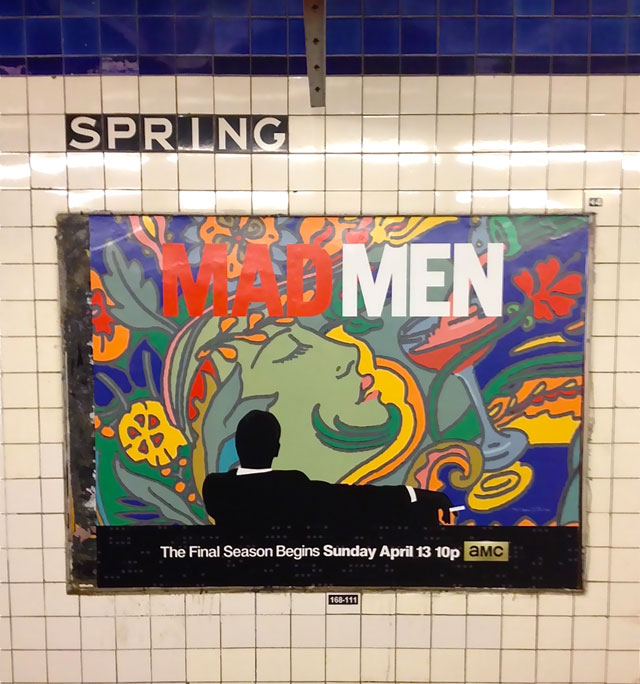
Glaser’s ‘Mad Men’ poster (photo by Andy Mills)

 Sara Cwynar. A shot glass with the leaning tower of pisa. A t-shirt boasting of a trip to the great wall of China. Souvenir kitsch and its unfortunate consequence; emptying history of meaning. Cwynar takes as her subject the image and the fallacy of the thinking that a souvenir photograph can capture the living world in its print. The layers of material with which she covers her staged and appropriated photographs is intended to disrupt the false sense of authenticity we receive from a photo. Her fascination with kitsch is born of the fact that history is over and our attempts at its preservation are flawed and meaningless.

img-sara-2_165658182731
Sara Cwynar “Girl from Contact Sheet 2” 2014


Laurie Anderson, Performance Art vs. Theater, and Minimalism

Laurie Anderson “works in real time.” That’s her take on what differentiates her from theater artists. A response to that age-old question of what really is the difference between certain performance art and theater.

Anderson, who made a name for herself in the aftermath of performance art movements such as Fluxus and minimalist musicians such as John Cage, has experience with many different mediums, separating herself from the Fluxus artists whose ‘happenings’ earned them a spot in the art history book but whose artistic merits rested more firmly in the tradition of philosophy and protest movements than it did in true art (although that term’s definition is up for debate.)

Professionally trained, Anderson is a renaissance man when it comes to artistic practices; she writes music, she designs sets, she writes dialogue, sings, acts, and more. If you see something on stage at an Anderson performance, she designed and most often fabricated the piece or set.

I’m drawn to Anderson for many reasons, not least of which is her innate ability to defy easy classification.

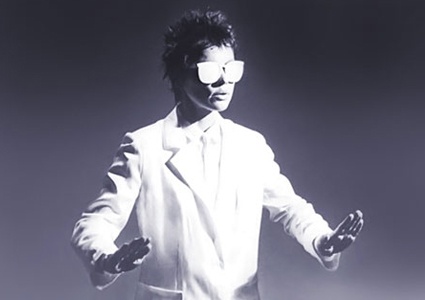
68blog_laurie

The recipient of an extensive education in the visual arts, Anderson achieved notoriety for, for lack of a better term, performance art, but has left a lasting legacy that is often most closely associated with independent music, owing in large part to her radio ‘hit,’ “O, Superman.”

Despite what she’s known for now, in Anderson’s prime, she spearheaded a form of performance art that bridged the gap between the ‘happenings’ of the 1960’s and the opportunities that video would provide artists and performance artists in the 1970’s and 80’s.

But Anderson’s sensory overload productions were only part of what earned her a place in the history books. It goes without saying there has been no shortage of meaningless ‘art’ that stimulates plenty of senses. No, to enter the canon, as it were, Anderson had to create content and dialogue and a production that would coalesce to deliver something imbued with meaning and importance. That’s exactly what she did.

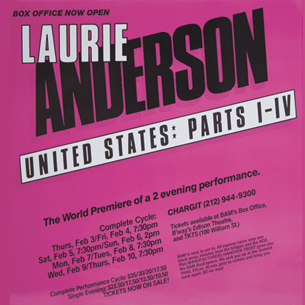
In the 1970’s Anderson began performing a set of performances she collectively entitled “United States.”

In the over seven hour work which skips precariously between topics, Anderson simply used her unique style to portray the (or at least a) collective American dream, in this case broken up into four parts: transportation, politics, money and love, resulting in what was referred to by the New York Times as a “pop Opera.”

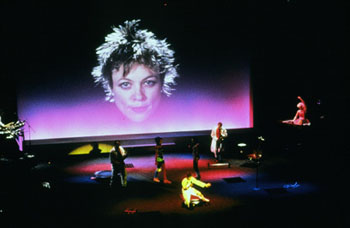
laurie_anderson

The lengthy staging featured Anderson performing her act solo. Singing, ‘dancing,’ miming, talking, conversing (with herself), performing ‘stand-up’ and playing musical instruments (many of which she had altered or straight up invented. She was a pioneer in the combination of unique synthesizers). She tells stories, she sings songs, she changes her voice (Anderson is synonymous with instruments which could alter her voice so she could perform as numerous characters). Sometimes she makes sense, sometimes she doesn’t. Images are projected, props are used, she uses and re-uses musical themes and more. If you’d seen it (or if you have), some of it you’d like, some of it would speak to you, some of it you’d hate, some of it wouldn’t make any sense but you’d probably leave feeling like you hadn’t totally wasted your time and you’d certainly leave impressed by Anderson’s talent and creativity.

Despite the way it sounds, Anderson’s work is strangely minimal. Not minimal in the visual or even sensual sense, but rather in the artistic, performative sense. A sense wherein the performance itself is defined as the copresence of the performer and their audience. One cannot exist without the other. And just as with minimal art, the experience of the artwork is dependent upon the temporal and spatial condition in which the audience member views the artwork.

Here’s what I mean, and here’s a key differentiator between performance art (at least Anderson’s style) and theater.

While it may not always be the case, it can be widely agreed upon that playwrights very predictably utilize their work to vocalize or artistically express their philosophy, worldview or some kind of life experience.

Anderson doesn’t do that.

If you go to an Anderson performance expecting to learn about Anderson, you’re shit out of luck.

Artists_LA_3_LaureAnderson_poster_305

Anderson’s performance art is minimal in that she utilizes herself as a medium, “elucidating ideas and notions from a cast of characters” without ever indicating when she is playing Anderson and when she’s simply using her voice to as the vehicle for someone else.

Anderson’s purposeful obscuring of herself (both implicitly and explicitly through disguising her voice) in order to express myriad viewpoints and portray myriad characters allows her audience members to draw their own conclusions and experience the art in their own way, just as a viewer experiences not Donald Judd’s silver boxes, but rather the space between and around them.

She skews our collective notion of performance art, subverting it to her own aims of forcing us to question where the thoughts and voices she is acting as a channel for are coming from. Are they coming from us? Are they coming from our friends? Are they simply imaginary?

According to Anderson, her approach to theater and performance leaves her “freer to be disjunctive and jagged and to focus on incidents, ideas, collisions.” The fact that there is no cohesive structure, no attempt to create true characters or project the future allows room for the audience to work with the creator in orchestrating a complete work of art. Just as Judd and others rely on audience members to complete their sculpture with spatial experience of it.

Anderson was and is an incredibly unique artist whose artwork defies categorization while redefining what we think of as performance art. She’s hard to understand, combining frenetic, sensational productions while at the same time serving as the proponent for a unique, minimalist take on performance. And, as mentioned previously, despite a prolific output, you’ve been fooled if you think you know anything about Anderson from her art.

the groundless declaration of independence and can eating salad truly be considered art?

“Dada was born of a need for independence, of a distrust toward unity. Those who are with us preserve their freedom. We recognize no theory.” 

Or so declared Tristan Tzara in his Dada Manifesto of 1918, ushering in an era of anti-art and art as a method of protest.

When Dada was born the idea of an anti-art, second nature to us now, could not have been more shocking.

)As an aside, it’s not easy to imagine anything in art falling under the label of “shocking” ever again? Disappointing.)

Nevertheless, for the society of the early 20th century, Dada was shocking, and the ideas it spawned; art as protest, humor in anti-art, the intention to shock and a post-modern refutation of tradition and standards, would spawn many similar and similarly shocking art movements over the next century.
url-2

One in particular, one of the more interesting and either most accessible or least depending on how you look at it, was Fluxus.

While on the surface the group appeared radical, I posit they were simply picking up where Dada left off and formulating an artistic language for a new generation, a generation, which struggled with how to react to the massive technological and political upheavals that were happening all around them.

So what is Fluxus? And how does one defend the practice of eating salad as art?


Fluxus was born in the 1960’s without a unifying statement or clear direction.

Despite George Brecht’s (a founding Fluxus artist) rejection of a credo as central to Fluxus’ identity, several other founding artists attempted to create one anyways, albeit a very untraditional one. The most well known declarations were those of George Macinuas who wrote Fluxus Manifesto’s one and two.

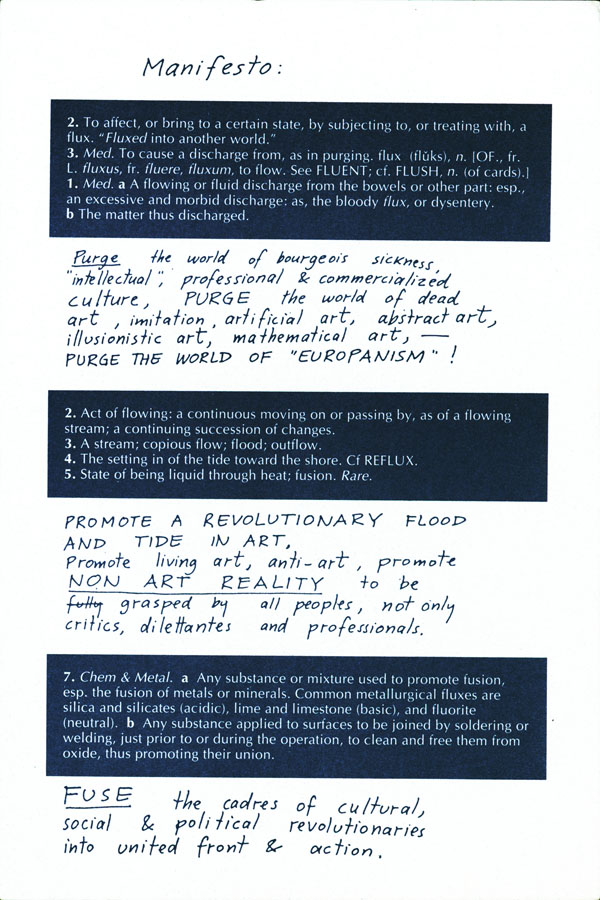
In Manifesto I, which Maciunas authored in 1963, the three core principles of Fluxus, at least as Macinuas perceived them, were established. Taking as a starting place the dictionary definitions of three central words and adapting them to his purposes, Macinuas elucidated Fluxus thusly (abbreviated):

  1. Purge the world of the “intellectual” and commercial culture. Purge the world of dead or illusionistic art.
  2. Promote living, anti and non-art which can be grasped by all people
  3. Fuse the cadres of all revolutionary groups into one

It was to be a rejection of everything he and his contemporaries viewed as standard and accepted, as well as an incitement to cultural revolution.

Fluxus, just as Dada before it, spurned the notion of acceptance and strove to create a counter-culture.
maciunas-menifesto1

The loose group which assembled under the name of Fluxus was made up of many artists. George Brecht, George Macinuas, Dick Higgins, Yoko Ono, Nam June Paik and Allison Knowles to name a few. They were the Neo-Dada in their conscious attempt to disrupt normalcy.

Fluxus art was a great many things but above all, it was action based. Performances were central to the Fluxus artists. New media was also essential. The Fluxus artists explored the use of electronic music and film extensively and very little ‘traditional’ art was categorized under the name due to its conscious reactionary stance against the mediums of the ‘system.’

Due to the temporary nature of the group’s most famous medium, the happenings or performances, much of what we know of Fluxus art is in the form of descriptions. Descriptions of what sounds like little more than organized chaos.

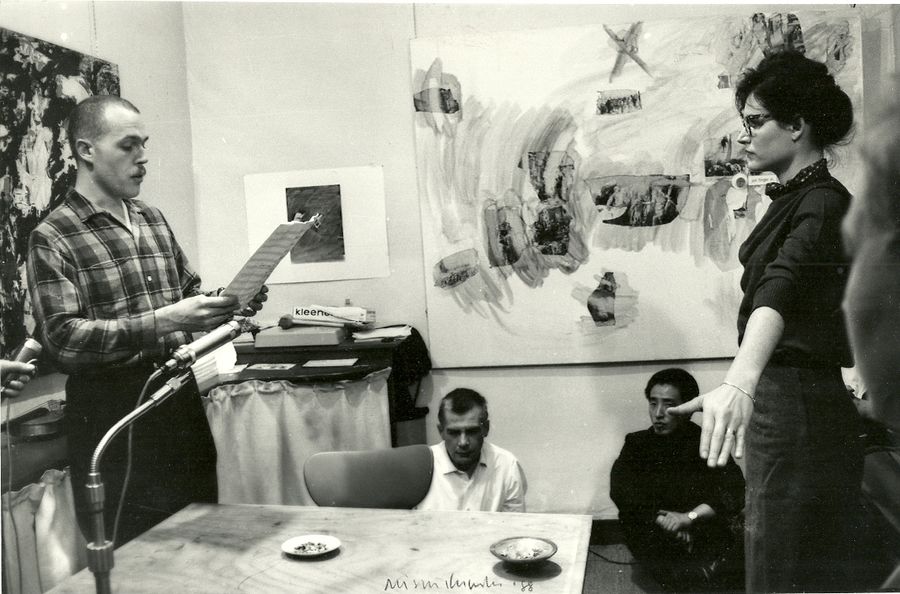
Fluxus was inaugurated, for all intents and purposes, at the first official Fluxus event in Wiesbaden, Germany. The event was called Festus Fluxorum and was organized by Maciunas. Participants included Knowles, Higgins, Brecht and Paik among others.

I won’t give a full account of the ‘performance’ but here is a taste.

Four men stand behind a table in formal suits rhythmically clapping their hands. One man blows a kazoo. Knowles forcefully sits down then stands up. Wooden blocks are smashed. Paik plucks a violin. Paik paints with his hands. Paik spits tomato juice onto a canvas. Knowles repeatedly shouts “Never, never” while another reads incomprehensible statements from a book.

I could go on.

Fluxus was born.

Fluxus movements occurred throughout the world in the aftermath of the Wiesbaden birth, and many artists grouped themselves under the conceptual umbrella of these “revolutionaries.”

One of the more famous, and actually remaining Fluxus works, was Paik’s “Zen for Film.” 23 minutes of nothing, blank film, often considered to be the first example of video art.

In my headline I alluded to a Fluxus performance by Knowles called Proposition. In the piece, performers go through the steps required to create a salad; cutting the vegetables, assembling the dressing, etc.
url

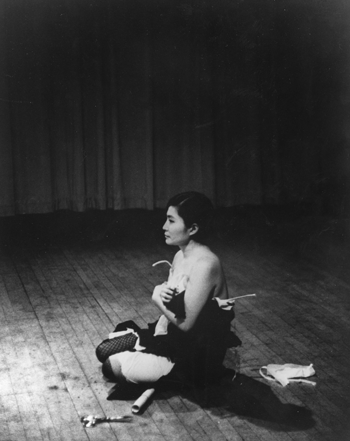
Another example of a Fluxus performance is Ono’s Cut Piece, in which she invited members of the audience to cut away pieces of her clothing.

Suffice to say, Fluxus art could be anything provided it was governed by a general lack of structure, a calling of attention to the daily or mundane and demonstrated an overall lack of ‘skill.’

Examples abound but the idea of the performances is really summed up in my detail of the Festus Fluxorum. They weren’t, contrary to what you might suppose, random events, but actually carefully choreographed acts. Fluxus work could take innumerable shapes; a book, videos, combinations of multiple media, etc.

It’s weird, it’s nonsense, but say what you will, the movement is an important part of art history so it’s impossible to ignore.

I’m inclined to think Dada got it right and Fluxus took what is really an interesting notion to the point of no return, at least apart from legitimizing nonsense in art for a whole generation of artists to follow. A legitimization which would be unabashedly abused.

I’ll come back to me in a minute, but first, here are some ways Fluxus artists attempted to translate and elucidate their work to the public.

Dick Higgins said of Fluxus that it was “not a moment in history, or an art movement. Fluxus is a way of doing things, a tradition and a way of life and death.”

Fluxus artists touted their art actions as attempts to imbue the ordinary with meaning. By transforming things like sleeping, making/eating dinner and jumping into art, those things themselves became art, in their opinion. It’s kind of abstract but hopefully you follow. Intention is, after all, what sets art apart from the ordinary in this century.
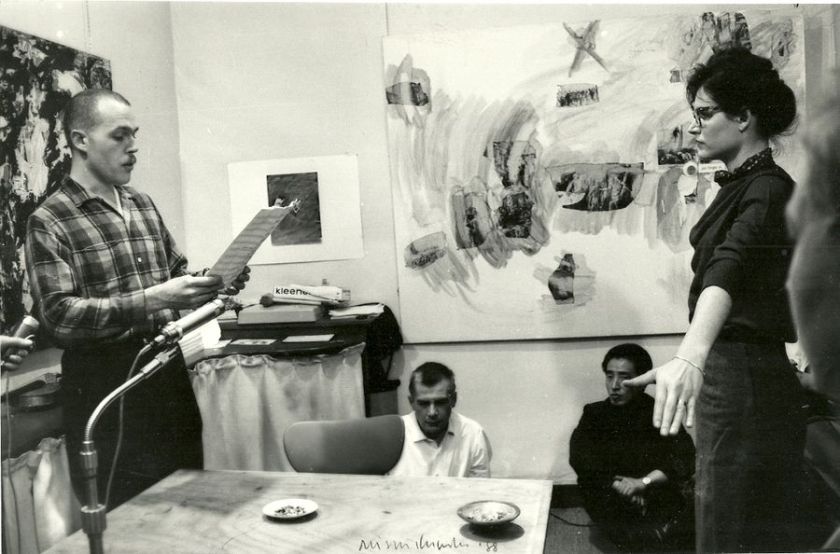
url

Fluxus artists strive for a lack of structure, they wanted their undiluted concentration to be the only thing keeping their art from being nothing more than random chance.

In the words of Fluxus artist Allan Kaprow on his happenings, it was time to move into the art, instead of just looking at it. Art should consume your time and fill an environment, something a mere painting could rarely do.

As mentioned earlier with Macinuas’ Manifesto, the Fluxus artists were reacting to an art world dominated by the elite and the intellectual and their nonsense and talentless work was their preferred method of revolution; the elimination of the professional in art.

Bringing modern art to a less elevated level is a noble aim, but by reducing art to nonsense, is that really what you’re accomplishing? Or are you simply altering the meaning of art, something that seemingly, or at least should, by definition implies a skill or talent?

In Macinuas’ Manifesto II, his “Fluxmanifesto on Fluxamusement” he attempts to do that very thing. Maciunas states the artist must demonstrate his own dispensability. “He must demonstrate that anything can substitute art and anyone can do it…Amusement must be simple, amusing, concerned with insignificances, have no commodity or institutional value…It must be unlimited and eventually produced by all.”
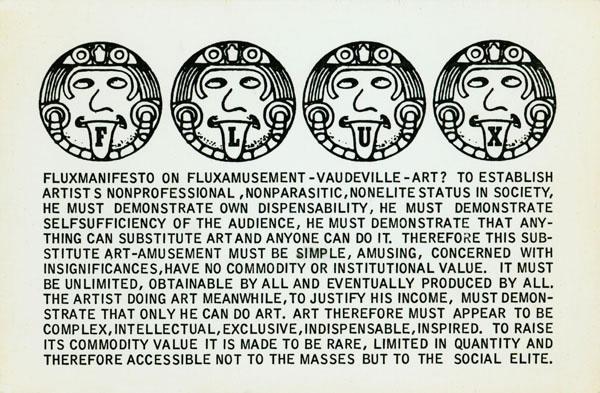
Flux-manifesto

The second manifesto was a harsher reaction to the art world while also a defense of Fluxus as non-serious art, something anyone who had already seen a performance would have deduced.  It reaffirmed the importance of the general public to Fluxus art as well as the self-sufficiency of the audience. They too could perform what the ‘artists’ were performing.

It was the notion of anyone as artist that most likely contributed to a decline in Fluxus practice. Rampant “performances” and “happenings” caused the idea to lose originality and fade into obscurity as it was impossible for the public to distinguish between the serious practicioners and the frauds.

One defense of the movement more valid than most others, is the centrality of Buddhist thought to the Fluxus practicioners.

Ellen Pearlman delves into the Eastern religion’s influence on the movement in great depth in her study Nothing and Everything.

Knowles, when speaking of her performances often used Buddhist terms for meditation practices and an idea central to the Eastern religion is the lack of a duality, an idea which Fluxus embraces in it’s attempts to make art both serious and not-serious.

There is a definite meditational quality to much of the work that was created by the artists which on the surface appears pointless and boring. Paik’s “Zen for Film” for example, could be nothing, or it could be an intentional calling of attention to the pieces of inert matter that naturally fall onto a camera or backdrop, mimicking the activity of the blank mind in meditation.

url-1

It, just like Buddhism, sought to find and accentuate the value of the ordinary. To eliminate commodification and highlight individual experience. To embrace opposition and formulate and live an active philosophy of existence.

Artists who caused the notions of Buddhism to be central to their art insured that their art “sidestepped aesthetics through the act of immediacy and the inability to erase or second-guess one’s moment of creation.” (Ellen Pearlman, Nothing and Everything)


In Buddhism, art is an integral part of life and for Fluxus artists, the paramount aim was that art would resemble life. Therefore in their art, as in life, once a decision was made, it was final.

Again, all noble aims.

You can see where I’m going with this.

I recently read Jed Perl’s dissection of Ai Wei Wei as an artist in The New Republic, an essay in which Perl states Wei Wei has “no particular aptitude for art.” Despite the fact that the man is currently a subject of a solo show at the Hirshorn and has works in museums from the Tate to the Metropolitan.

As anyone who knows me is well aware, I am in a constant struggle with how to rationalize my love, or lack of love, for an artist or a style with his/her/it’s place in art history. In Perl’s piece I found some much needed confirmation that it is indeed okay to disagree on art.

Which is exactly where I stand with Fluxus.

The intention was noble and the reactionary stance understandable. The method is what loses me.

We will always want to react against the establishment. It’s in the nature of people, especially young people. Tumultuous times exacerbate the need and as everyone knows the 1960’s and 1970’s were enigmatic decades. The Fluxus artists were asserting independence from a world they didn’t understand, run by people to whom they could not relate.

If only they could have taken some of their worthwhile notions such as independence, individuality and the desire to allow everyone, not just the elite, access to art, and created a valuable method of expression and communication.

What we were left with instead was a group of people who wanted change but lacked a vision for what that change should be. Instead they floundered in a sea of nonsense, random acts and spectacle.

It was an art that didn’t make sense for a time that didn’t make sense but while attempting to express the feelings of a generation, I believe it served to devalue the very notion of art. While gaining a place in art history due in large part to it’s novelty and it’s philosophical similarities to Dadaism, Fluxus leaves much to be desired.

Tzara sought above all the preservation of an artist’s freedom. The Fluxus artists chose to capitalize on their relatively new freedom without explicating a clear and challenging vision concerning their intention.
Making the Connection: Impressionism and Post-Impressionism

So much of the information each of us inhales on a minute by minute basis is isolated. We read a story about a vote coming before Congress, a bomb that went off inside a Greek supermarket and a defense of Richard Nixon, but each are laid before us with no context and therefore little to no meaning.

So it goes with art. It is frighteningly easy to go through your life without burrowing beneath the surface of an image or an object (what art is, in its most essential form.) We are bombarded by images. Who has the time?

We are a checklist culture. We have the ability to see and read and do more than people in centuries preceding could have even dreamed. But do we really gain fulfillment or even enjoyment out of any of it? Is this endless barrage of opportunities a blessing or a curse?

renoir.moulin-galette

I would argue it is neither. It is rather something in the middle, but something fundamentally antithetical to human nature’s tendency. This checklist culture? It emerged because it was intrinsic. Choice and opportunities don’t necessitate happiness.  In fact, quite the opposite, they breed malcontent personalities with the inability to attain happiness without stringent effort.

That being said, recognition is the first step towards conquering an obstacle. Once the emptiness, to return to the analogy of art, of looking without understanding, is grasped, efforts can be made to counteract the lethargy with which we undertake our most important endeavors.

So goes my life. A constant battle between my natural inclination to check my list and move on to the next line-item and the effort it is necessary to exert to follow my desired path of deeper understanding. The sense of fulfillment when you realize you can discuss a painting or whatever your curiosity of choice may be, on a level you once thought was reserved for a nameless elite of which you would never be a part, as an example.

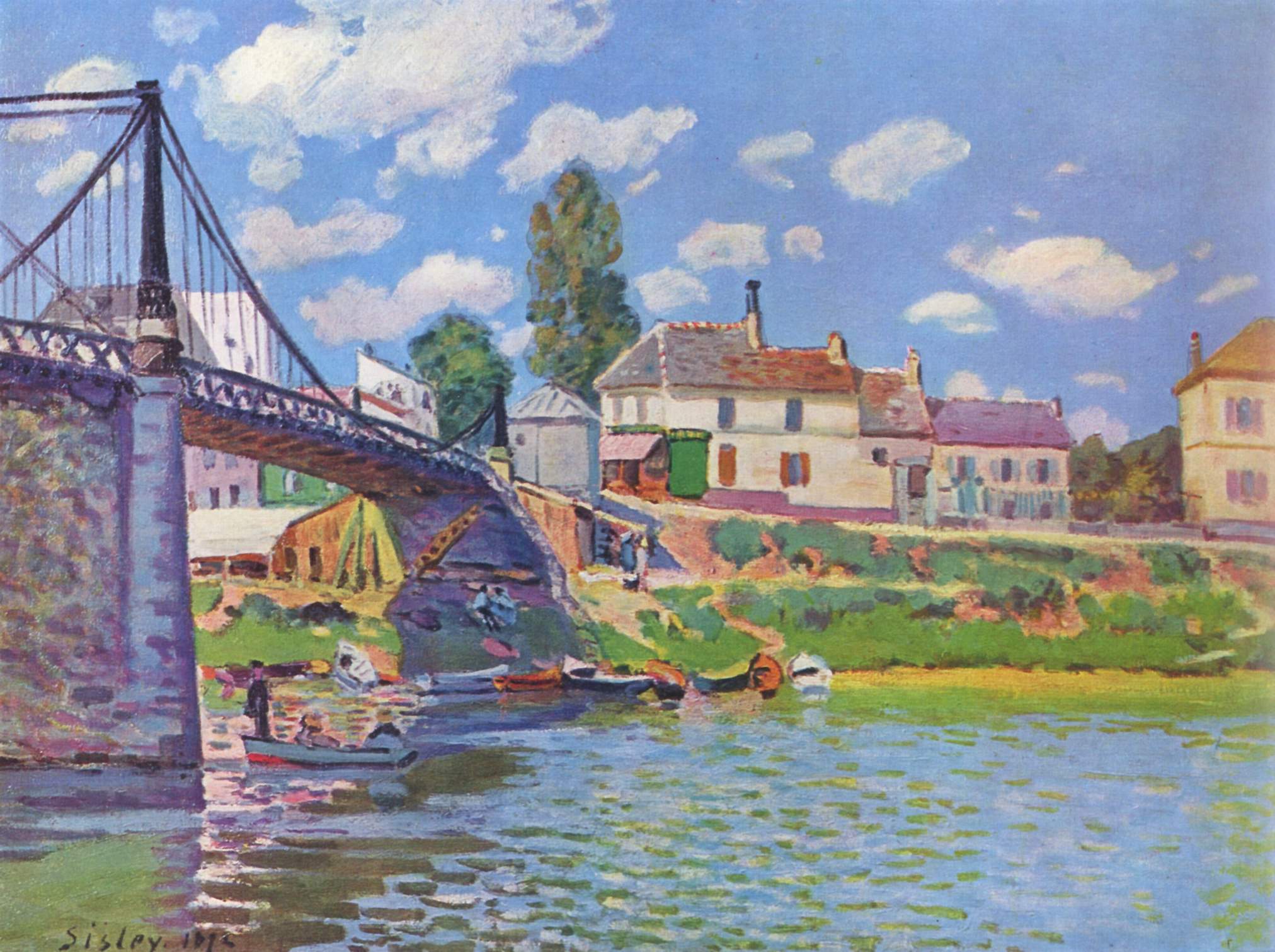
bridge-at-villeneuve-la-garenne-1872

The point at which a connection is made. When a deeper understanding of an issue or a painting is reached by contextualization. That is when the work becomes worthy of the time.
As an example.

I have always been fascinated by art. Not in the way in which I want to create my own art, but rather the ideas behind the art and it’s pattern and history. The pursuit of a deeper understanding has led me to reach beyond what I see in museums and into the context of a piece, a movement or an artist. And it is that search that has cemented the interest and love, which started before I understood why.

It happens on a daily basis, or at least it can, these connections. For example, I often find myself searching for the differences between movements, especially those which were similar and contemporaneous. I don’t mean the visual differences, those are oftentimes obvious, but rather the fundamental differences. The point at which the artists and their critics drew a differentiating line and why the line was drawn to begin with.

Impressionism and Neo-Impressionism. The perfect example.

Two movements that truly encapsulate the importance of art history. They were the point of departure for almost every important movement which would follow; the beginning of modern art. They also emerged so close in succession and their vitality and color on first glance seems so similar, it’s easy to wonder what the difference is. Did the neo or post-impressionists reject the impressionists, or at least their dogma? And is that the reason for the distinction?

Impressionism in a nut-shell, at least the parts important to understanding its relationship to what preceded its rise and what would supplant its prominence.

Claude_Monet_015

Unlike the dominant art, which came before the impressionist painters, this new brand of artist rejected an attempt at understanding the world around them. They were adamant in their refutation of the need for representation and leant instead towards the desire to “reflect the colorful surface of life.”

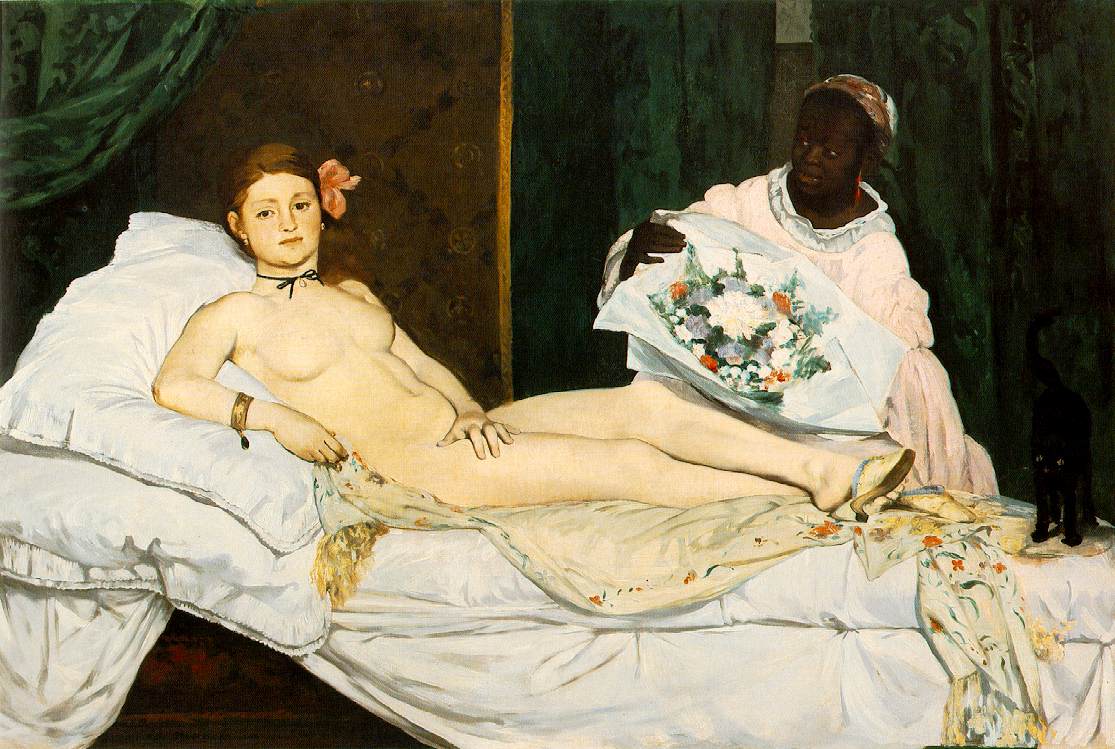
The relativity of the world, an idea which would take off in the subjective ideology and even morality of the 20th century, was captured in the work of Monet, Manet and their contemporaries. Everyone comprehends the world around them differently, why shouldn’t artists be allowed to embrace this fact and use their talent to capture it?

Manet,_Edouard_-_Olympia,_1863

Art was forever changed. It was the birth of subjectivity in art, a cornerstone for nearly every modern artist who was to follow. The dogma of artistic tradition was destroyed and instead, we learned to value individual experience and the artist him or herself.

Where would Marcel Duchamp have been without the path the impressionists paved for his radical notion of idea as art? The impressionists ushered in the notion that the subject of an artwork was subordinate to the personality and touch of the artist who was its creator. Taking that notion and subordinating the artist again to the idea, is only a natural evolution.
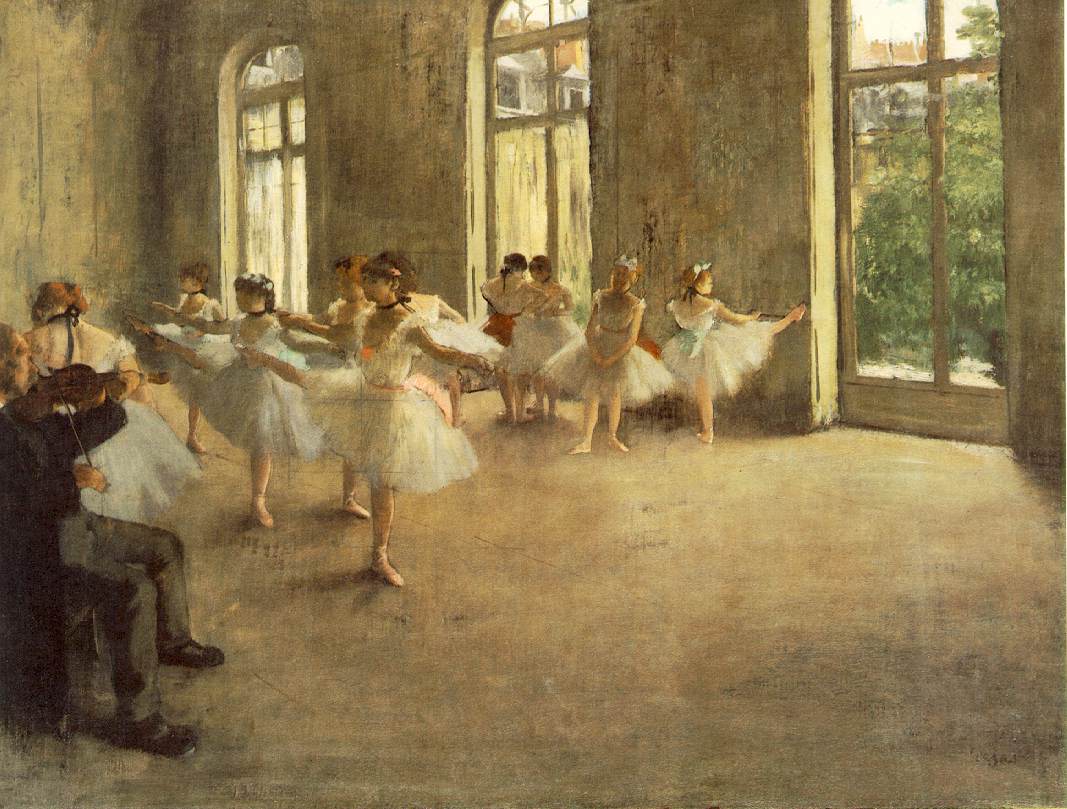
degas.rehearsal

The Impressionists captured the moment and our notion of their moment is one of beauty, charm and vibrancy. Movements that were to follow, such as the Expressionism of Kirchner and Munch, owe their identity to impressionism as well, and the subjugation of representation to relative visual understanding morphed into a style of art that was focused on the human as opposed to the world around him/her while retaining the subjectivity and emotion of the impressionists’ attempt to capture the world as they saw it.

Neo-Impressionism. The jumping off point.

Although they owed much to the impressionists, and knew it, the neo-impressionists were an entirely different breed of artist. In the opinion of this writer, the differences that divided these two schools of thought concerning the role of art in society and from whence it is derived, represent the two fundamental aesthetics and ideologies which have dominated much of the art that has followed in the 20th century.

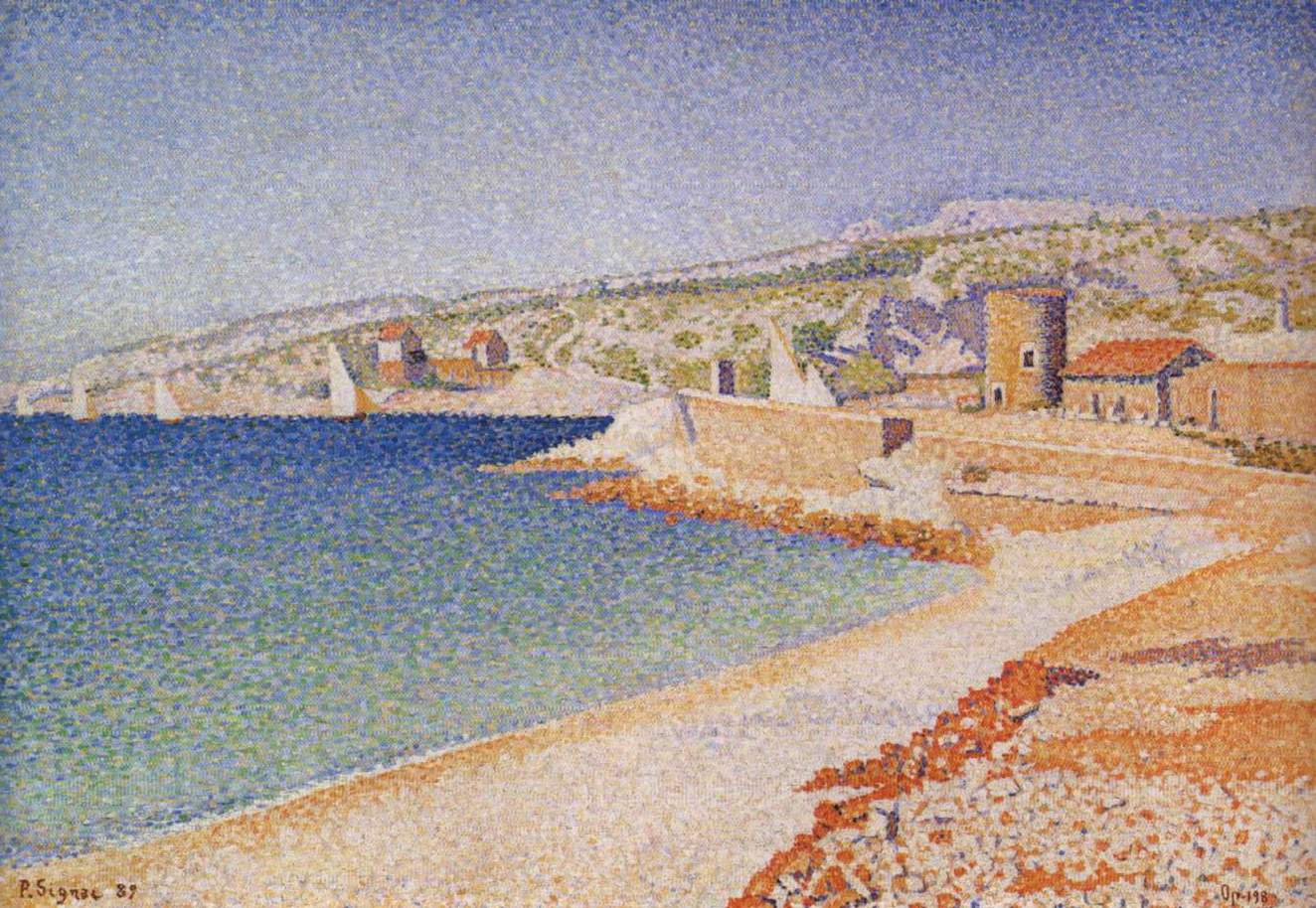
Paul_Signac_-_The_Jetty_at_Cassis,_Opus_198

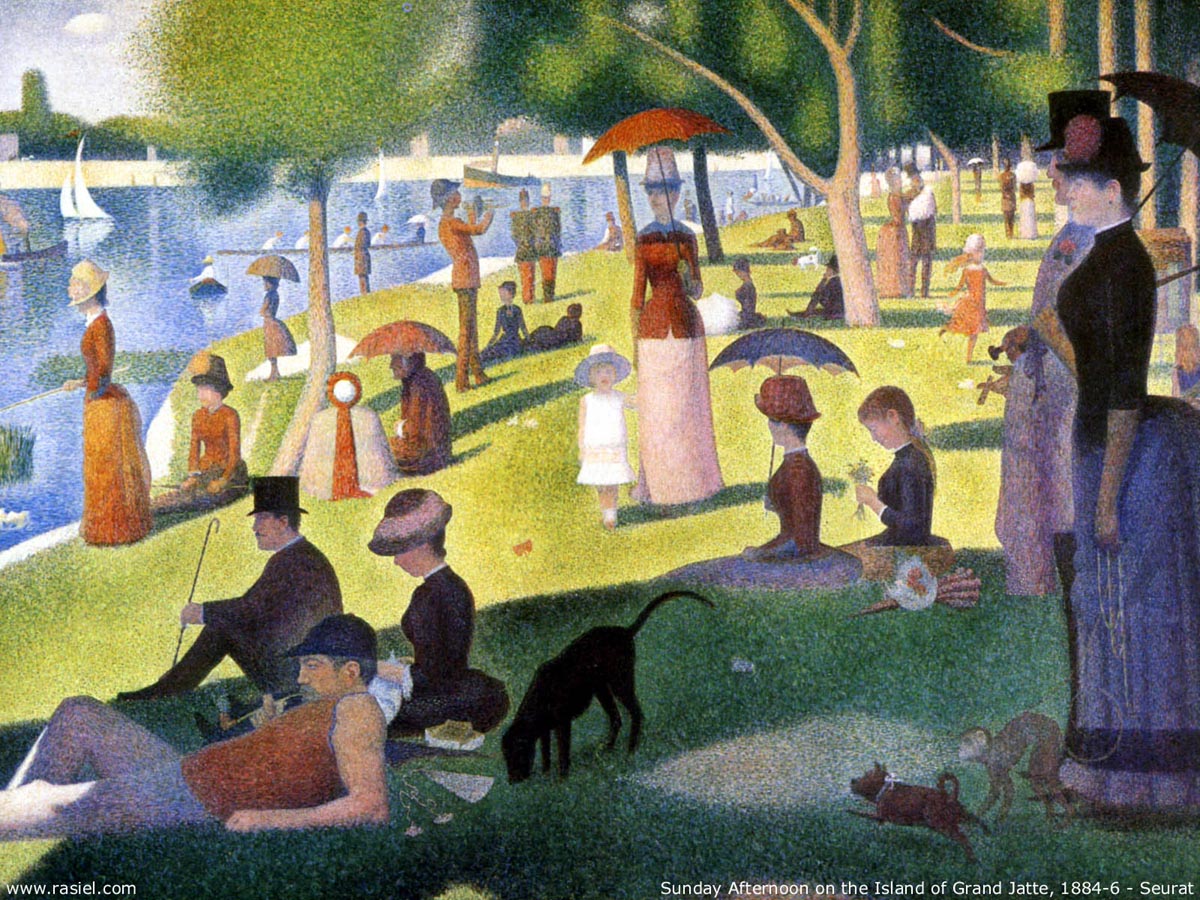
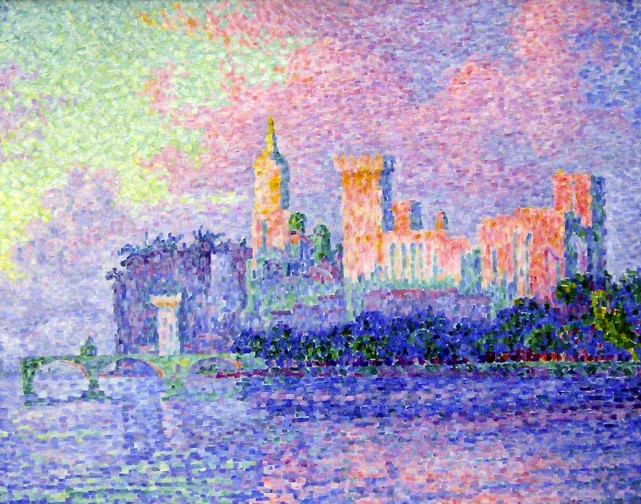
Neo-impressionism, and namely Georges Seurat and Paul Signac, initiated art’s love affair with science. True, an accurate depiction of life was not what was sought, but the spontaneity of the impressionists was too much for Seurat. Instead sciences were studied, geometries were consumed and theories and methods were strictly developed and adhered to.

The mixing of colors that was central to the beauty, newness and atmospheric quality of the impressionist’s work was anathema to Seurat who thought the process “dirty.” The purity of color was his paramount aim and it was Seurat’s belief that this purity of form would convey a certain prismatic brilliance in his work. Seurat even wanted to dictate the place at which viewers should stand to view his work to create the ideal mixing of color on the retina.

Seurat sought a permanence in art, what he called “art in function.” With pointillism and divisionism (painting in separated areas of color), he wanted to create a scientific method for art, he labored in the effort to pictorially recreate the ideal way for the optical lens to translate distinct colors into a vibrant work of art. It was methodical and painstaking, the exact opposite of the impressionists.

Seurat_SundayAfternoonOnTheIslandOfGrandJatte

Hence the distinction.
Where-as impressionism introduced spontaneity and subjectivity into art, neo-impressionism introduced scientific pattern and an attempt to create the ideal art.

Almost all art that has followed in the 20th and 21st centuries has been characterized by either complete subjectivity or an attempt to let scienctific patterns dictate the art, removing the subjectivity without, however, reverting to the objectivity of classicism. It’s fascinating if you think about it. Two art movements which on the surface could be valued solely for pure aesthetic pleasure, actually fomented an entire century of art. A revolution we will most likely never see again.
In a book I recently read, the short lifespan of neo-impressionism was explained thusly; no theory or method will ever supplant the creative spirit, no matter how hard one labors in the effort to create the ideal. When Seurat and Signac’s art form became yet another dogma, the vitality of originality was extinguished and it was time for another artist and another movement to rise in it’s stead.

pointillism2

Artists and movements were to rise and fall in the aftermath of the impressionist’s revolution, but never again would objective or representational art have a foothold in the new and respected art forms. Subjectivity and science were king.

Connections.

They, by definition, complete and fulfill. Nothing exists in a vacuum and everything starts somewhere. So it goes with art. Without context it might be impossible to decipher just why the impressionists and post-impressionists were so vitally important to the history of art.

Checklist conquered. Understanding achieved.

The complicated world of Appropriation Art and Sherri Levine

I don’t have an inordinate obsession with Duchamp but here I am again, discussing a contemporary artist who owes him a massive debt.

Appropriation art. Appropriation in the art world, according to Google, is defined as “the artistic practice or technique of reworking images from well-known paintings, photographs, etc., in one’s own work.”

It’s not really a new thing. Artists were appropriating the art of other artists long before the genre became historically defined and prevalent in the 1970’s and 80’s.  Picasso and his studies of Velazquez’s “Las Meninas” come to mind as a well-known example.

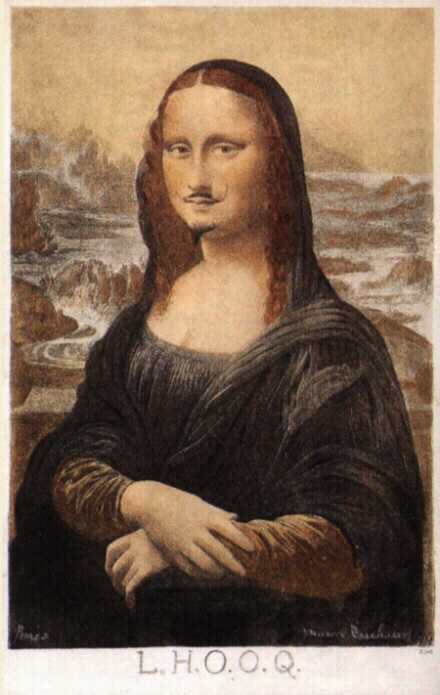
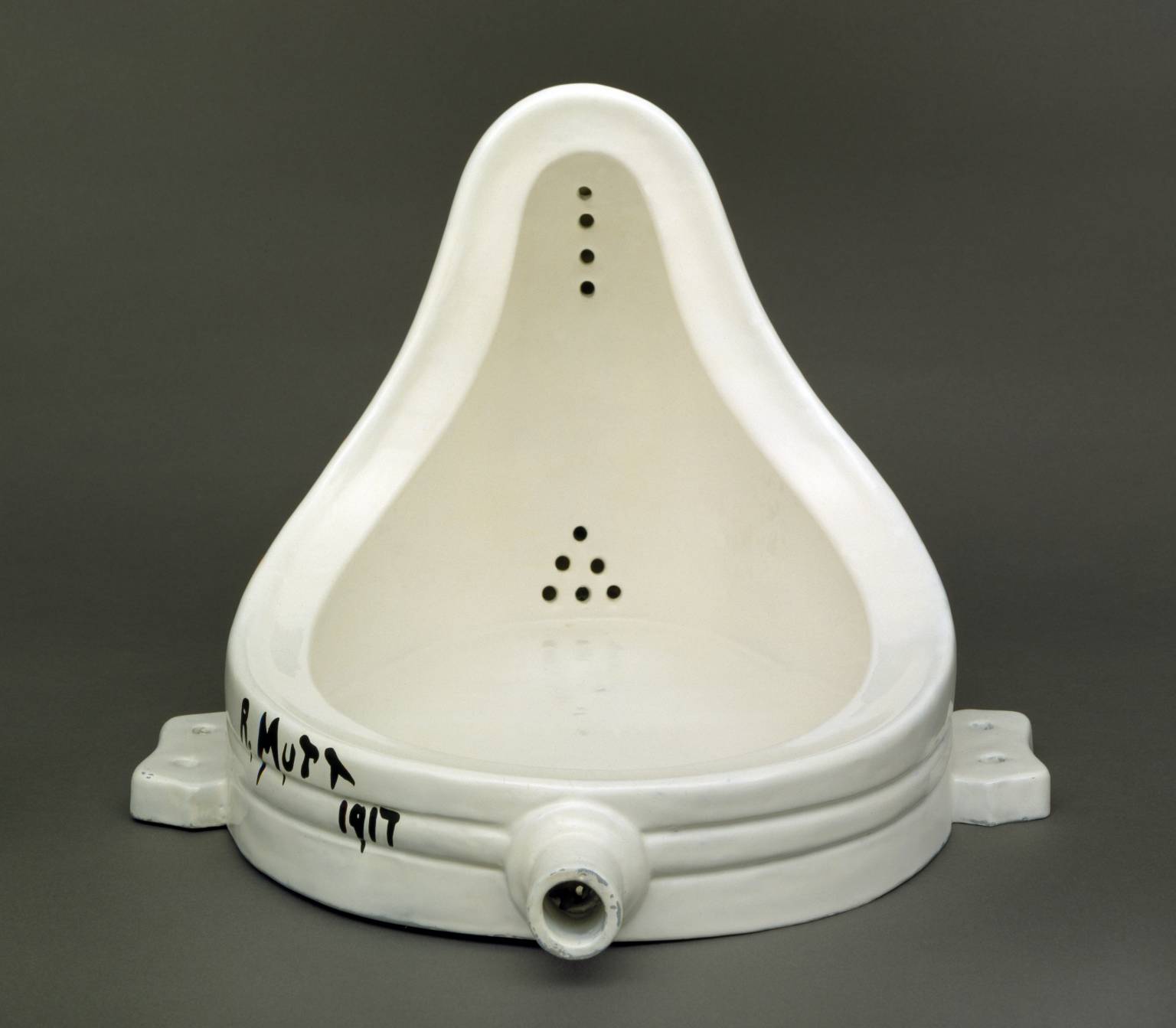
Appropriation art as we know it began with Duchamp’s giant art world fuck you, commonly referred to as “Fountain.”

Fountain 1917, replica 1964 by Marcel Duchamp 1887-1968

By appropriating a mass-produced, straight from the factory item, rotating it and signing a name, Duchamp ushered in a new era of art-making, the era in which the idea would trump the creation. Modern art would now be defined not by beauty, artistic skill or intricate detail but rather the concept embodied in whatever the artist chose to call his/her art object.

Many art movements followed Duchamp, some more conceptual than others, but regardless of to what extreme the artist took the importance of conceptualism, in most serious forms of art, the concept was paramount.

Appropriation was also prevalent. Dadaism grew in the decades after Duchamp and the Dada artists continued Duchamp’s ready-made legacy with more appropriation of everyday objects.

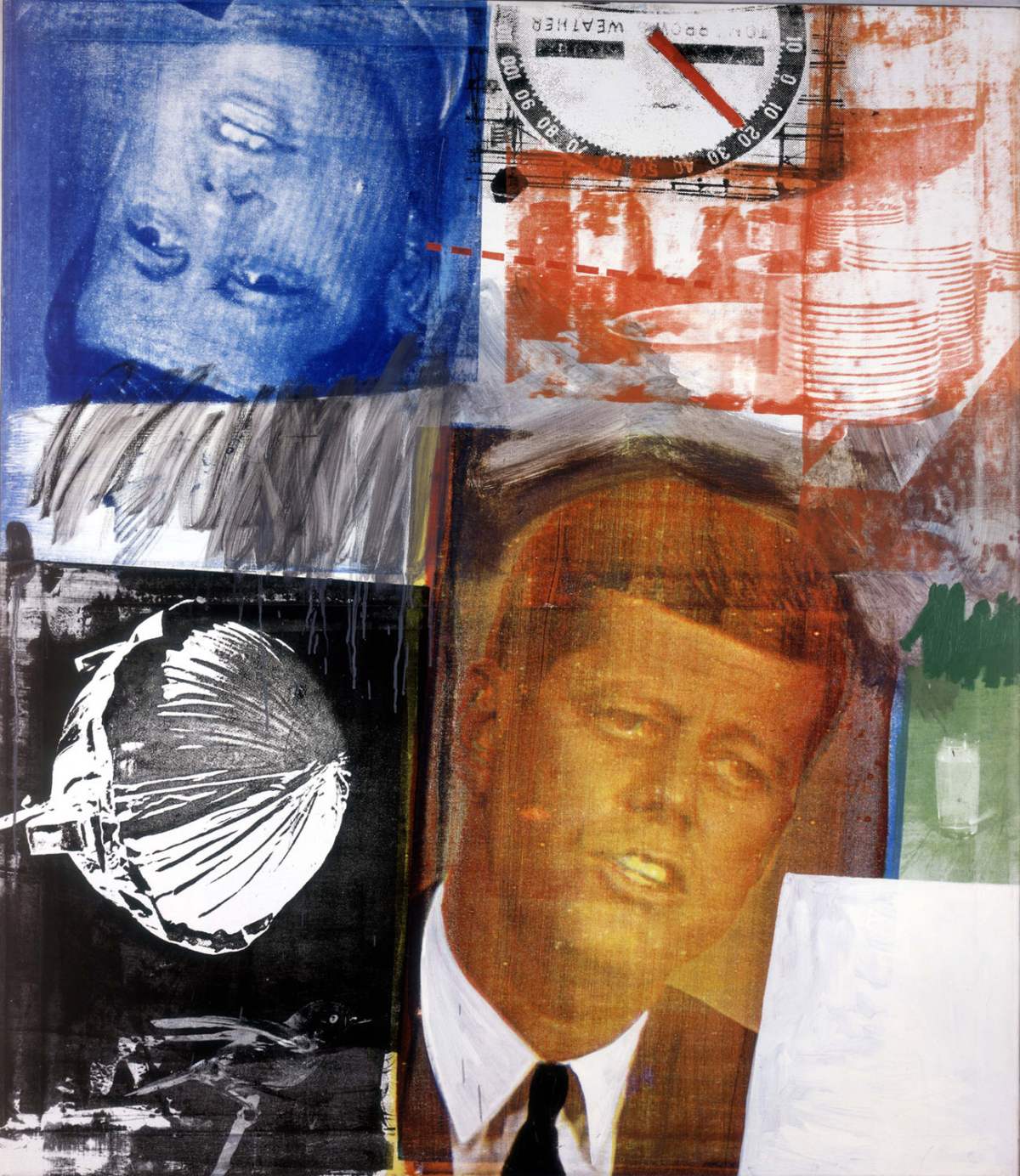
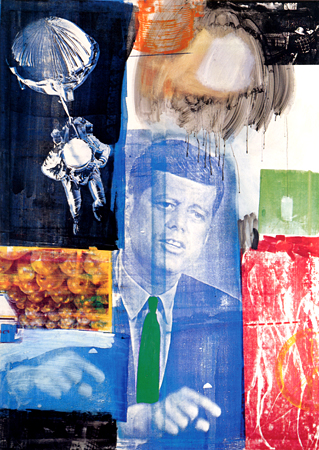
In the 1950’s, Robert Rauschenberg and others used the concept of the ready-made but in a more involved way with intricate collages of found objects and their seeming allusion to, and critique of, the places we assign these objects in life.

Retroactive I - Robert Rauschenberg
Retroactive I – Robert Rauschenberg

Pop Art exploded in the 1960’s and Andy Warhol and Roy Lichtenstein appropriated images from pop culture such as the iconic Campbell’s soup can or in Lichtenstein’s case any number of kitschy comic images of over-sized men and women. By taking images that would be easily recognizable and modifying them as they saw fit, the Pop artists were inserting themselves into a previously created image and adding new layers of meaning to the reactions an image already produces in a viewer.

Pop Art, just as those previously discussed, again used art in the service of critiquing modern society’s ethos; in this case, it’s worship of celebrity and glamor, the exhaustive nature of consumer culture, etc., although it can be argued, Pop Art also served as an homage to the same.

By the 1970’s, the ground was set for a group of artists who would take the notion of artistic appropriation one step further, essentially redefining appropriation in art, and igniting a new level of controversy in the process.

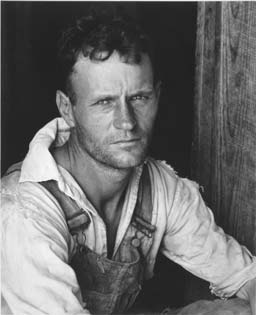
One of the first to stir up controversy, though certainly not the last or most famous was Sherrie Levine, who, in the 1970’s, made headlines for her series of photographs entitled “After Walker Evans.”

Walker_Evans_after_Sherrie_Levine_web

Evans, for those who don’t know, was one of the most celebrated modernist photographers in American history, famous for his poignant and iconic photographs of the depression era Midwest.

Levine’s series featured over a dozen re-photographed images of Evans’ photos. Apart from the fact that the photographs on display were not Evans’ original photographs and the occasional fuzz or discoloration, the visual differences are almost non-existent.

I know it’s not everyone’s cup of tea, idea art, but bear with me.

After “After Walker Evans,” Levine went on to other similar projects. Some of her most famous include her bronze casts of Duchamp’s “Fountain,” photographs of Egon Schiele’s dark self-portraits and her copies of paintings by any number of famous artists.

The prevailing theme? Almost no innovation on Levine’s part in conjunction with minimal artistic interference in the original work.

So is that really art?

1991fountain

Well, many in the art world unquestionably say yes, whether they derive aesthetic pleasure from Levine’s work or not. Assuming the people of the art world are not as a whole, insane (a taxing feat for some), then yes, it is art and here is why.

The first barrier to acceptance for some may be whether or not Levine is legally within her rights to call the copied photographs her own and as per the legal doctrine of Fair Use, she is. According to experts in the field, one of the exceptions to copyright law protected under Fair Use is when the work resulting from the original transforms and/or adds value to the original.

It’s interesting that in recent years, judges have been ruling harshly when cases against famous artists utilizing others images have reached court, most notably in the case of some Richard Prince appropriations and Shepard Fairey’s conspicuous Obama poster.

princecariou

In 2005, Jeff Koons was in a similar situation and the judge ruled in favor of Koons right to use a pair of legs taken from an Allure magazine photograph in a collage due to the “transformative” nature of the result. Anyways, that’s for another day.

Leaving aside the fact that who determines what “adds value” and how “transformative” something needs to be remains fuzzy, Levine’s work, although superficially not appearing to alter Evans’ photographs as is the case with the aforementioned artists, does add value to the photographs in the form of an idea; the very thing today’s artists are tasked so heavily with providing.

If an idea is what Levine brings to her photographs and transforms them to qualify as Fair Use, the idea is what must be understood and accepted.

One could assert, for instance, that Levine utilized her photographs as a critique of a media culture and the coming age in which images would become ubiquitous, each having been appropriated already a thousand times with no owner ever credited.

01-floyd-burroughs-bw1

Most likely what Levine was attempting to do with her photographs was to challenge the notion of ownership, an issue in my opinion which surfaced with the emergence of photography itself and has yet to disappear. Doesn’t the very technique of photography, with its use of an almost infinitely replicable print, make it difficult to accept as original art in the traditional sense?

In another sense of ownership, Evans did not own the Midwest or the people in his photograph, why should we allow him to call them his own?

Levine’s work can and should be interpreted with a subversive, sarcastic bent as she mocks the art world’s old-fashioned notion of originality as well as copyright. Obviously Levine desired to provoke. But while she did so with her tongue in her cheek, she genuinely alluded to issues she believed were inherent in the nature of art today (in her case the 70’s); ownership and originality. Levine questioned, as many before her, whether our notion of ownership was not too restrictive, and forced us to question and reevaluate as many had done before her, what constituted an original work.

When I think about it , Levine’s work makes sense in light of Duchamp. After all isn’t what Levine was doing with her photographs essentially the logical extension of what Duchamp did with his ready-mades? An object is declared art and we accept it as such, noting it is not the object that is important but the idea. The precedent was set and maybe what we should be asking is whether or not Levine is simply re-creating something Duchamp already did.

What Levine did do, however, is add another layer of murkiness in this complicated world of modern art, ideas and originality. By “creating” a work that was neither the original work nor her own traditionally defined “original” work, in an attempt to question our notion of ownership and copyright, she is updating Duchamp’s ideas for a new generation and adding the notion of celebrity. Is the criteria different for a household product, also an original creation of someone’s, than it is for a piece of “art” by a “celebrity?”

It’s a circular and altogether complicated issue and one I’m clearly still wrestling with myself, but it’s not as easy to dismiss as you might have assumed. When original work now equates to original ideas, nothing is all that easy to dismiss.